
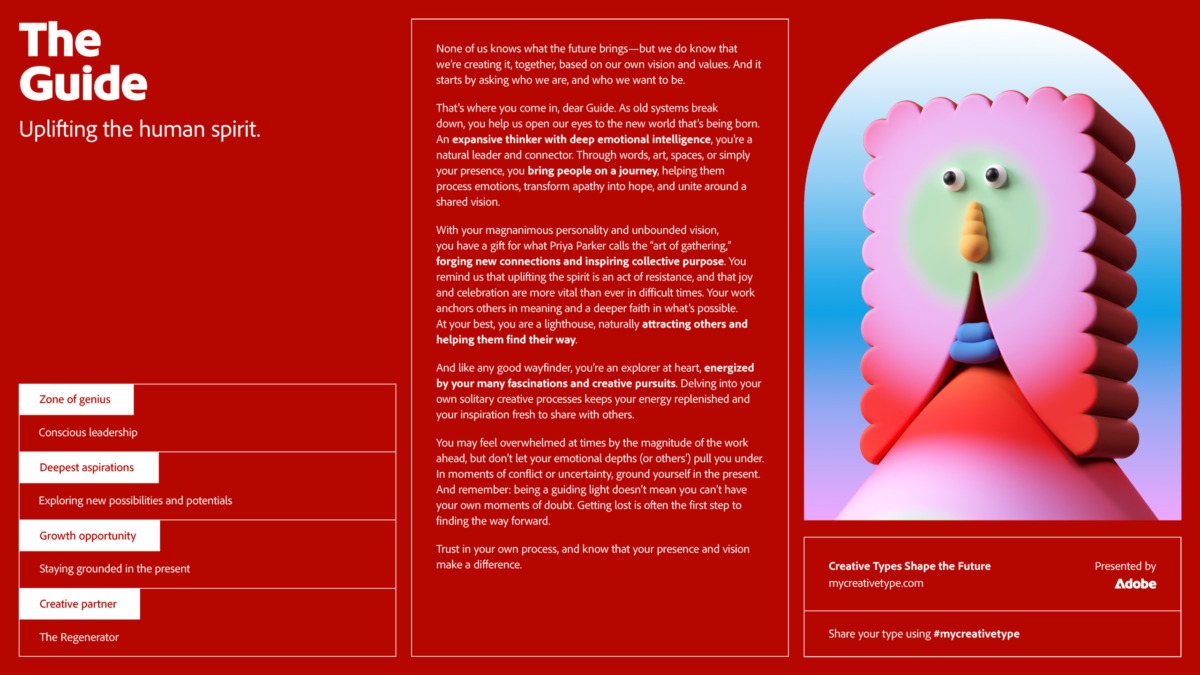
What kind of creative are you? Apparently… The Guide.
Most creatives have taken one of these tests at some point.
What kind of thinker are you. What type of mind. What box you sit in.
Usually, you take the result with a pinch of salt.
But occasionally, something comes back that feels… uncomfortably accurate.
I tried Adobe’s “What kind of creative are you?” test recently. Part curiosity, part procrastination. The result was “The Guide”. Which, for an automated test, is not a bad read.
It describes someone who brings people on a journey. A natural connector. Someone who helps others make sense of complexity and align around a shared vision. Someone who can turn uncertainty into something clearer, and more meaningful.
It also points out that getting lost is often the first step to finding the way forward.
Which, if you have spent any time in creative work, tends to ring true.
Because despite all the structure that surrounds it, the reality is that much of the job is navigating uncertainty. Understanding what the problem really is. Helping others see it clearly. And then working through that ambiguity to arrive at something that feels right.
That, more often than not, is the role of a creative director.
Not just to have ideas, but to guide thinking. To shape the conversation. To bring people with you. To move a group from uncertainty to clarity, and from clarity to conviction.
A lot of that comes down to how you handle tension. The tension in a brief, in a room, or in an idea that is not quite there yet. Or one that is there, but needs to be explained, tested and sometimes reshaped to make it stronger.
The description talks about conscious leadership and the art of gathering. The ability to bring people together around something that matters.
In practice, that rarely looks dramatic. It is usually quieter than that. Asking better questions. Creating space for honest conversations. Allowing ideas to be challenged properly, not just agreed with. Helping everyone involved feel part of where the work is going, not just observers of it.
It also mentions staying grounded in the present. This might sound abstract, but is actually very practical. Creative work rarely unfolds in a straight line. Things change. Priorities shift. New perspectives emerge. The ability to stay focused, adapt and keep things moving without losing sight of the bigger picture is often what makes the difference.
And then there is doubt.
The test points out that even a “guide” has moments of uncertainty.
Which feels important, because confidence in creative work is not about always being certain. It is about recognising when something holds, when it needs more work, and having enough experience to navigate both without losing momentum.
Of course, no test is going to define how someone works, and creative thinking does not neatly fit into categories. But what it can do is reflect something back. A pattern. A tendency. A way of working that has likely been shaped over time.
If anything, the idea of “The Guide” feels less like a label, and more like a responsibility.
Helping people make better decisions. Helping ideas become clearer. Helping work reach a point where it does what it is meant to do, and does it well.
Which, when you step back, is very close to how we think about things at Neon.
Not just creating work, but helping shape it. Not just delivering ideas, but guiding them through the process. Working closely with clients to get to something clearer, stronger and more meaningful than where we started.
Because in the end, that is what good creative work is. Not just expression, but direction. Not just ideas, but outcomes.
And if an automated test can occasionally reflect that back to you, it is probably worth the five minutes.
Equally, maybe I should guide myself away from online procrastination and getting on with the day job…
////
Written by Dana Robertson, Founder and Creative Director at Neon Brand Consultants, a Chichester-based brand consultancy working across sectors from law and finance to culture and start-ups.
////
If you have an upcoming project you’d like to talk about, then for sure contact Neon we’d be absolutely delighted to hear from you.
Please drop an email to or connect with via LinkedIn Dana Robertson.