
The value of a great brief?
It’s hard to exaggerate the importance of a good creative brief.
Quite simply, it’s what inspires and enables creative people to produce their best work, and deliver the best results.
A good brief helps shape everything that follows.
The initial thinking. The overall direction. Even fine details of execution.
Good briefs can often be a collaborative effort, but they are never written by committee.
They need clarity, focus, and candor.
On exactly who the audience are.
What the problem is that needs to be solved.
What the highest priority is, in terms of objectives.
What success will look like, and how it will be measured.
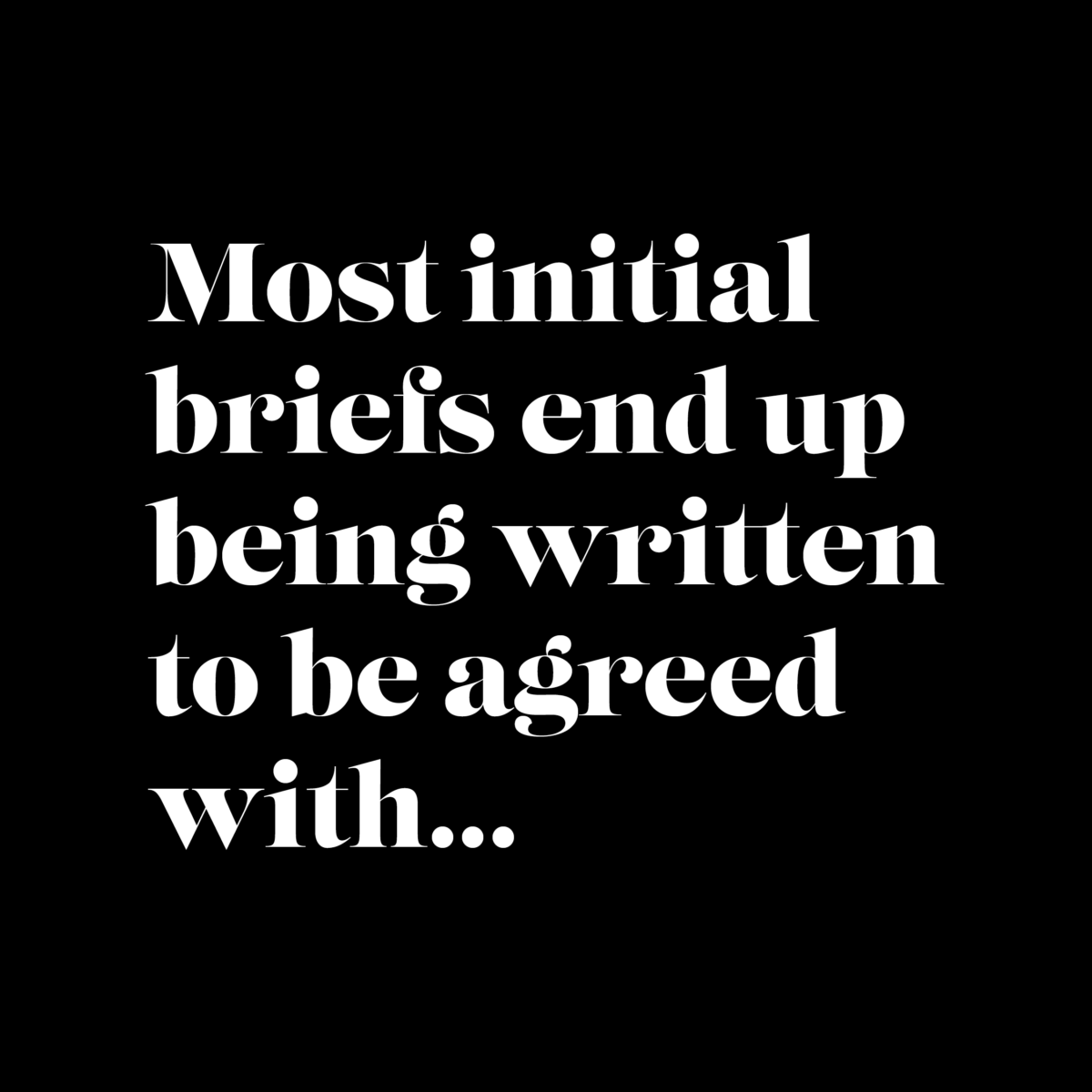
However, most initial briefs are written to be agreed with.
Not to produce better work.
And that can shape the outcome in ways you didn’t intend.
So what goes into a really great brief? Let’s break it down…
B is for Brevity
The clue’s in the name. Great briefs are never verbose or rambling. They’re concise, succinct, to the point.
They don’t try to cover all bases. They focus, sharply, on what matters most.
Because long-winded, flabby briefs almost inevitably result in work that lacks distinctiveness and competitive clout.
Or work that tries to do too much, and falls short of achieving any of its objectives.
By all means supply background information and supporting detail.
But not within the brief.
Other advantages of a really brief brief?
A short, sharp brief gets buy-in more easily, and creates a shared understanding right from the start, and throughout the project. So energy is spent moving forward, not pulling in different directions.
It’s easier to return to, when ideas are presented.
And it helps to prevent mission-creep as the work develop, and the project advances.
R is for Rawness
At their best, briefs strip away all the fluff and verbiage, and get straight to the problem that needs to be tackled. They don’t pussy-foot around. They don’t need to be overly polished, or polite. They don’t try to gloss over any uncomfortable truths.
It’s fine if they’re a bit raw. It’s a good thing, in fact.
A good brief shouldn’t try to solve the problem too soon. Because that way you can easily remove what is right in front of you.
Hidden in plain sight.
The essential ingredient.
The insight that unlocks a great idea.
It can also be tempting to try to shape a direction within the brief.
But it’s always better to present the problem clearly and have faith in the creative team it solve it.
The reward? Ideas you did not see coming.
I is for Insight
A good brief shouldn’t try to say everything, but it should say something meaningful.
It should provide not just information, but real understanding.
A clear view of the challenge and the opportunity within it.
It should be grounded in both evidence and empathy. In what people actually think, feel and do.
It’s the difference between just describing a situation and explaining why it exists.
Bold insight creates direction.
It gives the work somewhere to go. A reality to work with. Or a challenge.
Without insight to give it shape and purpose, a brief is just background information.
E is for Edge
A good brief should have edge. Not the aggressive kind, but intent.
A sense that something is at stake.
Something worth solving.
Something worth sweating over, to get it right.
It’s a gauntlet thrown down; a challenge to the creative team to do their best work.
It should openly acknowledge constraints. And provide clear guidance on the practicalities of what needs to be delivered, by when.
But beyond that, a good brief sets expectations and ambitions.
And often, it can be a little provocative – demanding a deeper, more thoughtful creative response.
Without edge, briefs can feel safe. Easy to agree with, but hard to act on.
With it, they create momentum.
They give people something to push against.
Something to respond to.
Something that fires the imagination.
F is for Freedom
A good brief leaves space for creativity to thrive in.
It leaves room to move.
Room to challenge.
Room to think differently.
Room, even, to tear up the brief, and completely rewrite it.
A brief that imposes too much control can limit what the work could become.
A little freedom allows ideas to develop in unexpected ways.
It allows for sideways leaps. Within a shared understanding of the goal.
It invites interpretation rather than just providing instruction.
And it is worth remembering the difference between control and constraints.
The right constraints can create clarity, and inspire innovative thinking.
And, with enough freedom, that’s often how the best work happens.
So…
Brevity, Rawness, Insight, Edge, Freedom
Right… back to the serious business of writing better briefs.
////
Written by Dana Robertson, Founder and Creative Director at Neon Brand Consultants, a Chichester-based brand consultancy working across sectors from law and finance to culture and start-ups.
////
If you have an upcoming project you’d like to talk about, then for sure contact Neon we’d be absolutely delighted to hear from you.
Please drop an email to or connect with via LinkedIn Dana Robertson.